
20: Serious Illness Conversations : SPIKES/NURSE
How to use SPIKES and NURSE to translate skills identified in Serious Illness Conversations.

If you have been following this Substack, you may think the foundation skills in “meaningful conversations” are only for oncologists or oncology trainees. The SPIKES model, while developed for delivering “bad news,” is effective across many situations as it is based on principles of communications Our framework highlights the essential tenets of central to human connections and communications: “active listening,” “active reflection,” and “empathy.”
As I mentioned in the initial post, in the literature, there are several different communication models for various situations (an example was the SDM model). In the SDM post, we translated the essence of the SDM model into the foundational model we are using here. By no means, do I want to minimize the amazing and effective models developed by amazing faculty across the field over 40+ years. This is just to keep things simple for learners starting their journey. It is easier to learn one model than five!
In this post, we will review the Serious Illness Conversations Guide from Ariadne Labs. Please visit this site for details and for treasure of information.
The goal of the guide is “to serve as a framework for physicians, nurses, social workers, chaplains, allied health professionals, and other clinicians to explore topics that are crucial to gaining a full understanding about and honoring what is most important to patients.” This allows for us to provide the care that the patients want which in turn “improve[s] in patient and clinician experience.” This delivery of goal-oriented care is what allows clinicians in intensive situations (palliative care, oncology, trauma and ICU) continue to provide good care without burnout.
So, let’s dive into this guide.
SETTING: Hospitals (ICU, floors) and high stakes office visits
AUDIENCE: Clinicians (doctors, APPs, nurses, trainees, SW, chaplain et al.,)
FRAMEWORK: On the left is the Serious Illness Conversations Guide, and on the right is the SPIKES framework
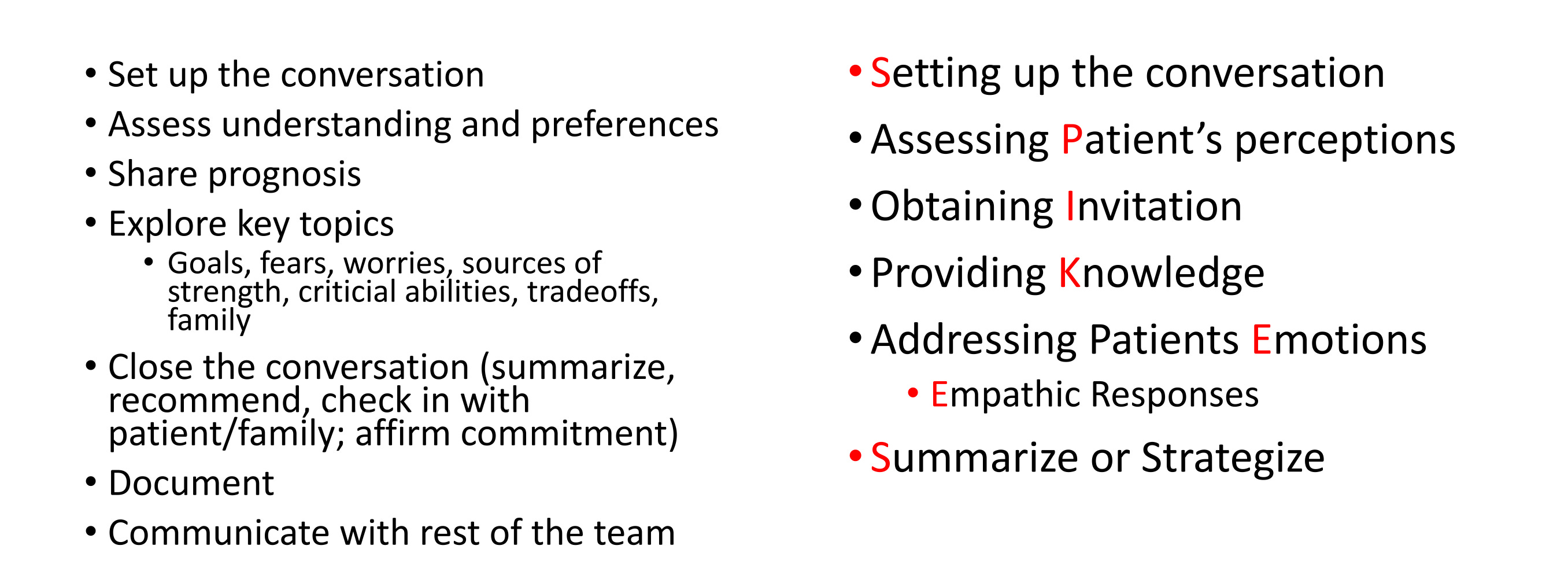
As you can see, the first two bullets (setting up the conversations and assessing understanding and preferences) are precisely what we have discussed in the “SP”IKES framework. Here, listening for and eliciting the patient and family to express their goals and preferences is key.
The third bullet, “share prognosis,” is as sharing information or knowledge in the SP”IKE”S model, and we should always seek permission before giving information.
The fourth bullet is where most of this model's work is being done. Until this moment in the conversation, we have listened to the patient’s story and their goals and preferences. Now, we must carry on a conversation and cover multiple points to ensure that all parties have the same information. This is where we use the iterative process of “IKE” discussed in the last post, how to conduct meaningful conversations. We explore patients' goals, fears, and worries, how they have handled prior stressful/difficult situations, and where their source of support and strength is. We may discuss the risks and benefits of the options in front of them. So, essentially, we are using the “meaningful conversations” framework for the fourth bullet.
In the fifth bullet, we are closing the conversation and hopefully having the patient/family summarize it to ensure we know what they have understood. This is the last “S” of “SPIKES.”
The last two bullets in the serious illness conversation guide are not covered in the SPIKES model. The last two bullets cover documenting the conversation and then implementing the plan including communicating it with the team.
The link here shows the entire guide with example phrasing (requires you to input your information). PLEASE look at these phrases, as they are developed with patient and caregiver input.
There is no mystery if you see the similarties to these different frameworks. Fundamental of all these different communication skills frameworks is the human connection. It’s that simple!
With care,
Biren Saraiya MD