
Asynchronous Communications

As I reflect on changes in communication in healthcare over the past two decades, I note several important changes with advances in communication technologies.
In early 2000, we had beepers and cellphones. In the hospital, doctors were paged overhead or were reached using a pager when a nurse needed to speak with the doctor. (There is a good anecdote for current trainees: for a new doctor to “market their name” in the hospital, they could call the operate to page themselves). Doctors were “paged” and then responded by calling back. Communication occurred when the doctor called back (or picked up a colleagues call) when they had the opportunity to respond. Many times they would be sitting down and looking at the EMR or their notes. Thus it was “synchronous communication”; one person talking to another where words along with emotions were communicated. The expected time to respond was less than an hour.
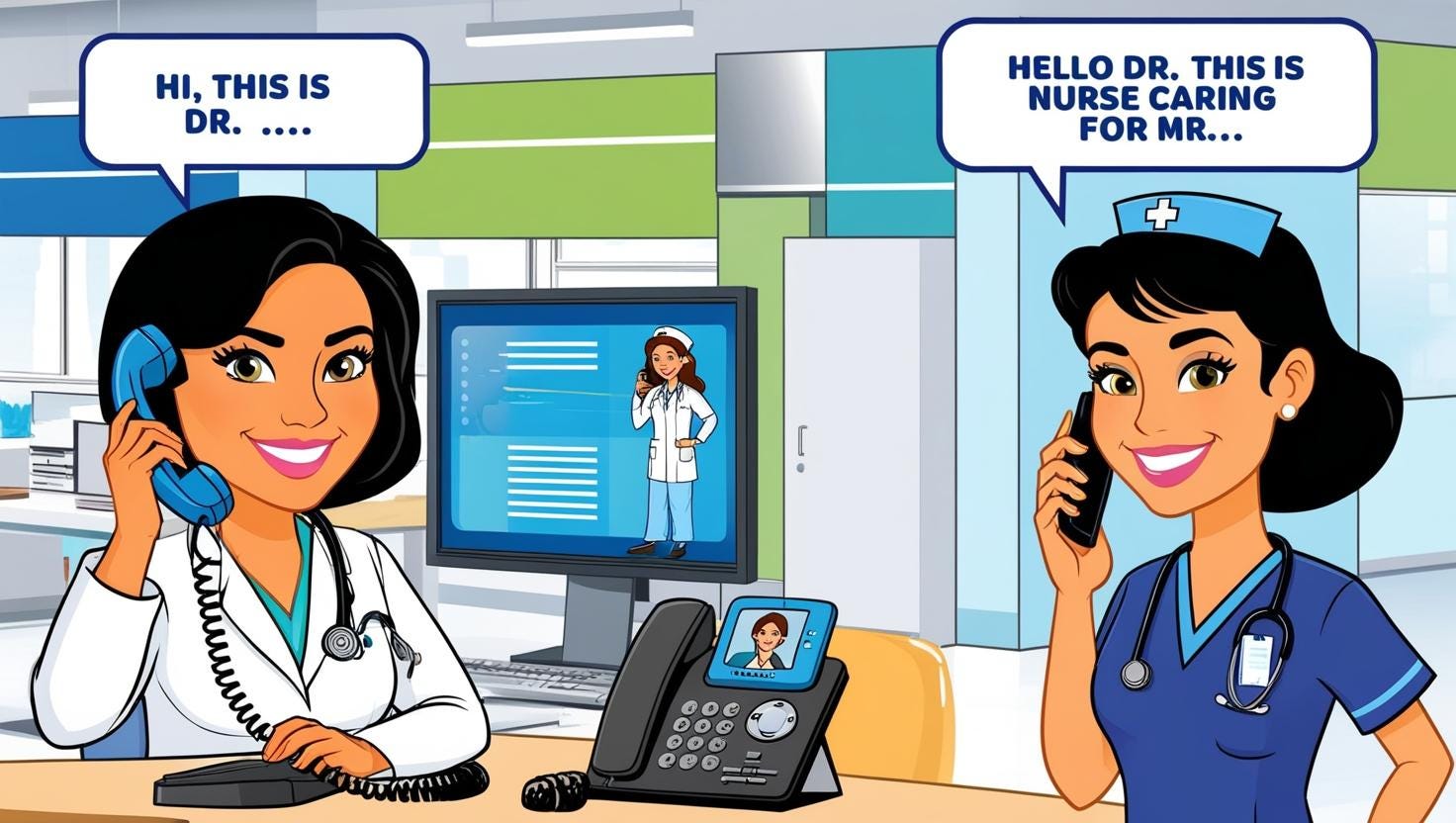
(Generated by AI on Canva.com)
In the early 2010s, we all had smartphones and text messages. Text messages made beepers extinct. Communications became more instantaneous and conversations started when the doctor ANSWERED the phone. It meant that there was less time to prepare for the patient (open the chart and anticipate questions). The communication was “synchronous” and emotions were conveyed as it was still verbal communication. Expected time to a conversation was now decreased to mere seconds or minutes. This ease of access created a new challenge: increased disruption in normal flow of care (more on this in a few paragraphs below).
In the 2020s, we are now “always connected” with secure messages and apps on the phone with notifications. Ease of access has increased the number of interaction (exponentially). Now the person initiating a chat will include multiple people for many reasons, such as they don’t know who the right person to connect with is. The expectation is that the response will be within seconds. Each of the team members who receive the message feels the urge to respond even if they don’t have the answer, and will sometimes add another set of team members (consultants with its own resident/fellow, APN, attending). And again, the same instinct to respond may prompt a response from a member who does not actually answer the question.
Each response generates a notification for EVERYONE on the message, and each time someone sees the message, the sender is notified that that person has seen the message and if there is NO response right away, there is the feeling of “being ignored” and that can potentially generate anxiety.
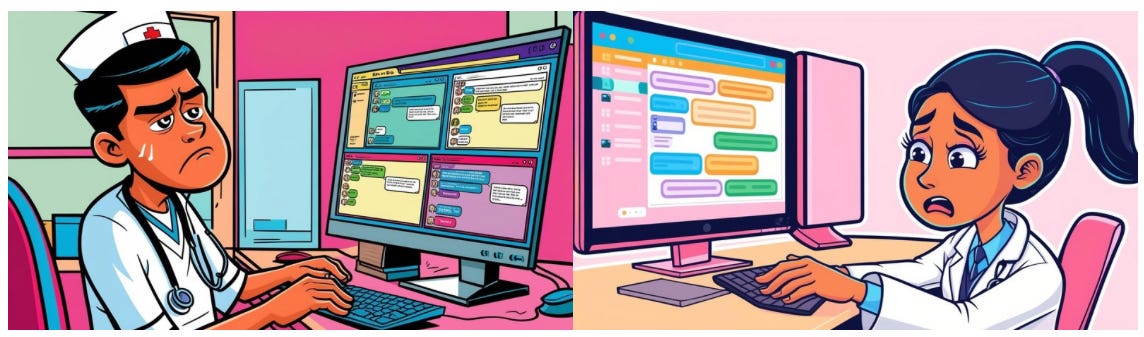
(Generated by AI on Canva.com)
Each response is a text message and thus lacks emotion and context. The reader of the original question reads the question in the context of their own mindset, regardless of why the question was raised. The response is written from their point of view, and the reader(s) of this first response each read with each persons’ own points of view, including their emotional status. So, if one is having a challenging day and the original question is not clearly answered, it creates a worsened emotional response.
Over time, the lack of 1:1 conversations and increased asynchronous communication creates inaccurate perceptions.
These changes in communication over the decades are summarized below.

The result is what was 1:1 synchronous and verbal communication has now become 1:many:many, asynchronous, and non-verbal communication. This has resulted in at least two major challenges for my practice.
increased disruption to normal work flow (IMO without improving efficiency)
teams not knowing each other, thus causing increasing negative emotions (lack of empathy towards each other)
The above two reflections come from my experience and reflections. Recently I heard that “only 2.5% of us can multitask” (Link), termed supertaskers. The 97.5% of us mortals do not multi-task, we task switch. This switching takes a cognitive load on our brain and decreases efficiency by about 10-25%. A great visual for this is your Chrome Browser, Try switching from one window to another, sometimes your browser will tell you how much memory it is using.
So if one had their “notifications” on during workday, each notification will create a micro-interruption which would take the focus AWAY from the task at hand, which includes patient care. Increasing number of interruptions can easily degrade quality of care.
The second important observation was lack of “knowing” each other and “assuming the worst” and increasing negative emotions towards one another. Early in my career, one of my mentors, Bob Arnold (now of Mount Sinai) taught me a great lesson in empathy. When I have a negative emotions towards someone, he taught me to ask ‘why would someone so caring, do something like…” That is easy to do when I am calm and much harder when upset. That is true for all of us.
I wonder how those reading this feel about my challenges, does anything resonate with you? Do you share these challenges? Other challenges? Please share your thoughts.
This post is part 1 of 2, in the next post I share some solutions to help all of us do deep and meaningful work.
Empathy and compassion for patients is preeminent to those of us in health care however in supporting care team, I find there is always room to be more compassionate to not just oneself but our peers at work.
This couldn't be more relevant given the current state of political and divide of values in our nation.
The resources the Compassionate Cultivation Course at Stanford is providing are phenomenal.
This video from Denmark hit a spot in my heart space.
https://youtu.be/jD8tjhVO1Tc?si=q1p-cEje4ox-L-a6