
Improving “asynchronous” Communications
May be have more synchronous communications?

In the last post, I identified several challenges I routinely face in deep and meaningful work. In this post, I highlight some of the changes I have made and identify a few that I am in the process of making.
The two major problems identified due to increasing asynchronous and indirect communication are:
Increased disruptions that interfere with deep and focused work, including patient care
Decreased empathy amongst team members due to lack of rapport
These challenges are throughout our lives, not just at the office. Recently, I heard Ezra Klein and his guests talk about the “attention economy” (read here, here —- I am sorry that it is behind a paywall at the NY Times and is framed in politics at times, just listen to the message. There is a Reddit post that highlights this, if interested). Essentially, in the current world of social media, what is being bought and sold is our attention, as the social media companies monitor how much time we spend on a particular post and video and use (sell) that to make money. Our attention is the commodity.
In the health care system, our attention is divided by notifications and messages, and these distractions are costing us and leading to potential errors and decreased efficiency. There is evidence for this from psychological researchers. For example, with heavy media multitaskers have lower working and lower long-term memory.
Notification Fatigue → “Notifications off”
One of the first changes I made was to turn off the notifications on my phone. By doing so, I got some control back and instead of someone else interfering with what I am doing, I get to choose when I interrupt my work.
This concept of less distractions is quite old. In the 2000s, when I lectured students on SPIKES, the “setup” aspect involved “turning off beepers.” The same principle applies here. It does not mean I am unreachable. I am certainly reachable by phone. As shown in the picture below, I won’t get interrupted by multiple people on numerous chats all the time.
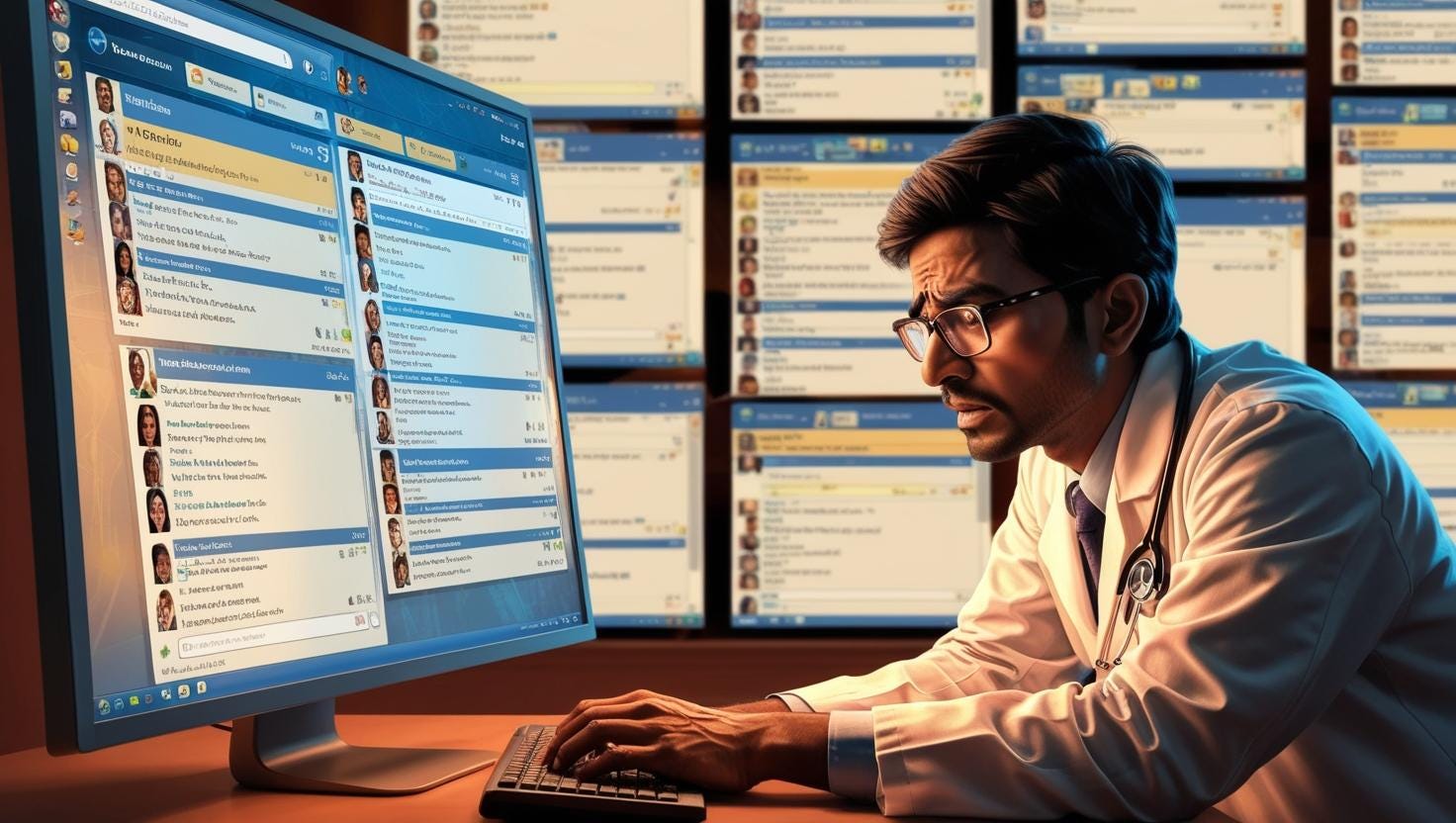
(Generated using AI on Canva.com)
This avoids the dreaded “alarm fatigue” as well. When there are multiple chats with multiple notifications, invariably it decreases focus.
More Face-to-face conversations
The second change I made was to improve the team function. I hated that my team of pharmacists and nurses who cared for my patients did not know me, and I did not know them. So, if I am having a “chat with someone” and we go back and forth two or more chats instantaneously, I pick up the phone, because clearly, they are on the chat and their attention is on the chat. Ok, it may not be face-to-face, but it is synchronous conversation.
Empathy and direct conversations to prevent “The Othering”
Behind a chat message, there is a person, with their own emotions, their own challenges and stressors. But to all of us, it is just a picture or a cartoon, unless we know that person. When we don’t know the person, we “other” them. In today’s healthcare delivery system, “othering” is happening more often than I recall.
So, how do I counter the urge for “othering?” I went old school. Reflecting on one of my first lessons from my mentor, Bob Arnold MD, and his teaching of “why would someone so caring, do something [so terrible]?” This was in response to the typical feeling an ICU resident has when caring for a dying cancer patient who has unrealistic expectations of outcome. “Why didn’t they have conversations with their oncologist (or rather, why didn’t the oncologist have that conversation about their impending death?).”
In that example, the solution to “othering” was to have empathy for the oncologist. That is the point of the quote, to encourage an empathic response.
In today’s world, which is mostly asynchronous, mostly behind the screen (phone, tablet or computer), othering is happening more often. The only way I know how to prevent is to create opportunities to prevent “othering” by creating environment that builds trust in each other. Face-to-face (or synchronous communication) does that, in my opinion. So, we instituted a change so the pharmacist was in our clinic. So, instead of three disciplines in three different areas, at least two were in proximity and could talk to each other. When I came out of the room, I would discuss my plan with the pharmacist and they would communicate with their colleagues in the pharmacy and nursing. If there were questions, we spoke with each other personally.
Initial observations of this trial: On a personal level, I love the fact that I am speaking with a person, rather than a chat. It has reduced the amount of chats back and forth significantly. Anecdotally, I heard that it has made my colleague’s frustrations lower (waiting for a response… when a chat is sent, we can all see who saw it and when… and if there is no response, we may feel offended). It has helped with patient care too, time to get drugs dispensed is shorter. So, subjectively we are feeling better and objectively, we are more efficient. (No, I have not collected before or after data.)
The most important benefit to me is to actually have more “meaningful” conversations because when face to face (or phone, thus synchronous), we communicate our concerns better. It takes less time to have a face-to-face conversation than multiple text exchanges.
How are these Meaningful Conversations?
As outlined above, Setup in “S”PIKES asks us to be focused and deliberate with our patients. Minimizing disruptions allows us to do just that.
In discussing empathy (E of SPIK”E”S), we highlighted the importance of understanding “the why” behind the question. The same principles that apply to patients (why did the patient ask that question) apply to our colleagues.
In Meaningful Conversations curriculum, we also talked about how we need to address emotions before facts. Our state of mind (mine, my pharmacists’, my nurses’) was driving the conversation. If I was in a negative emotional space (stressed, frustrated, angry), I reacted differently than when I was in a positive state of mind. When there are 15 people on a chat, each person has their own individual reaction to EVERY SINGLE message that comes across or doesn’t come across and there is a potential to trigger the next person’s reaction. When I am emotional, specifically negative, a simple question can be triggering. My response can be curt, short or downright rude (in reality or in perception with texting). When I am positively emotional (happy, relaxed), the same question presents an opportunity to connect with the person asking the question.
Thus, meaningful conversations are not just with patients, they are all around us. This work is ongoing and evolving. I wonder what other strategies are you considering in your teams?